Solar

If you're new to solar panels, both the technology and the installation process can seem complex. That's why we've put together this beginner's guide to solar panels.
We'll cover the basics, as well as delve deeper into what you need to know about going solar and understanding solar panels.
A solar panel is a collection of solar photovoltaic (PV) cells that absorb sunlight and convert it into electricity.
For most installations, technicians connect multiple solar panels to create a solar array. The components of a solar panel include the solar cells, glass casing, backsheet, metal frame and cabling to transmit electricity.
Thomas Edison developed direct current (DC) electricity, a circuit in which electrons flow in a single direction. DC electricity works similar to a battery powering a lightbulb: the standard in the U.S. until the 1880s.
Nikola Tesla believed alternating current (AC) electricity was a better solution because scientists could easily convert it to different voltages. This made AC electricity easier to transport over long distances.
The tide began to turn when George Westinghouse chose Tesla’s technology for the Chicago World’s Fair in 1893. AC electricity became the standard for the electric power grid in the U.S.
In fact, Tesla, Inc. is now the name of a company Elon Musk founded. The company uses AC electricity for its energy-efficient vehicles and solar technologies.
[Related: Tesla Brings the Nation’s Most Sustainable Neighborhood to Austin]
The sun’s energy is critical to all life on Earth, and humans have always found ways to harness its energy. As we know it today, solar PV technology has been around since Bell Labs created the first silicon cell in 1954. By 1960, solar cell efficiency had improved from 4% to 14%.
The solar energy industry continued to expand through the following decades. Solar technology improved because of research and development investments and solar interconnection regulatory frameworks that federal and state governments established. Both included policies such as tax credits, rebates and renewable energy standards.
[Related: Guide to Federal Solar Panel Incentives]
By 1999, cumulative installed solar capacity had reached 1,000 megawatts (MW). In 2000, while astronauts installed solar panels on the International Space Station, Sandia Laboratories invented the modern inverter. This inverter significantly improved system safety during power outages.
In the decades since, solar panel costs have fallen dramatically for two main reasons:
According to Statista, worldwide net solar PV power generation increased from 1,288 MW to 633,700 MW from 2000 to 2019.
Solar technology innovation will continue to advance. In turn, these advancements will make it easier for average people to acquire highly efficient panels. New systems also will likely focus on materials beyond or in addition to silicon.
For example, recent breakthroughs with perovskites may lead to higher-efficiency panels and the ability to coat surfaces with solar as easily as painting.
Given that the amount of sunlight reaching Earth hourly is enough to power the globe’s entire electricity needs for a year, solar power has practically unlimited potential.
Solar panel manufacturers use various solar cells and solar technologies, but the most common solar cell material is silicon (Si). Silicon is a key component of different solar panel types, each with unique advantages and disadvantages. But depending on how you use solar energy, knowing the benefits of emerging solar cell technologies using additional techniques or materials is important.
Manufacturers make solar cells from silicon and build them with a positive and negative layer that creates an electric field, similar to a battery. Most solar panels are made from either monocrystalline or polycrystalline silicon.
[Related: Who Makes the Best Solar Panels]
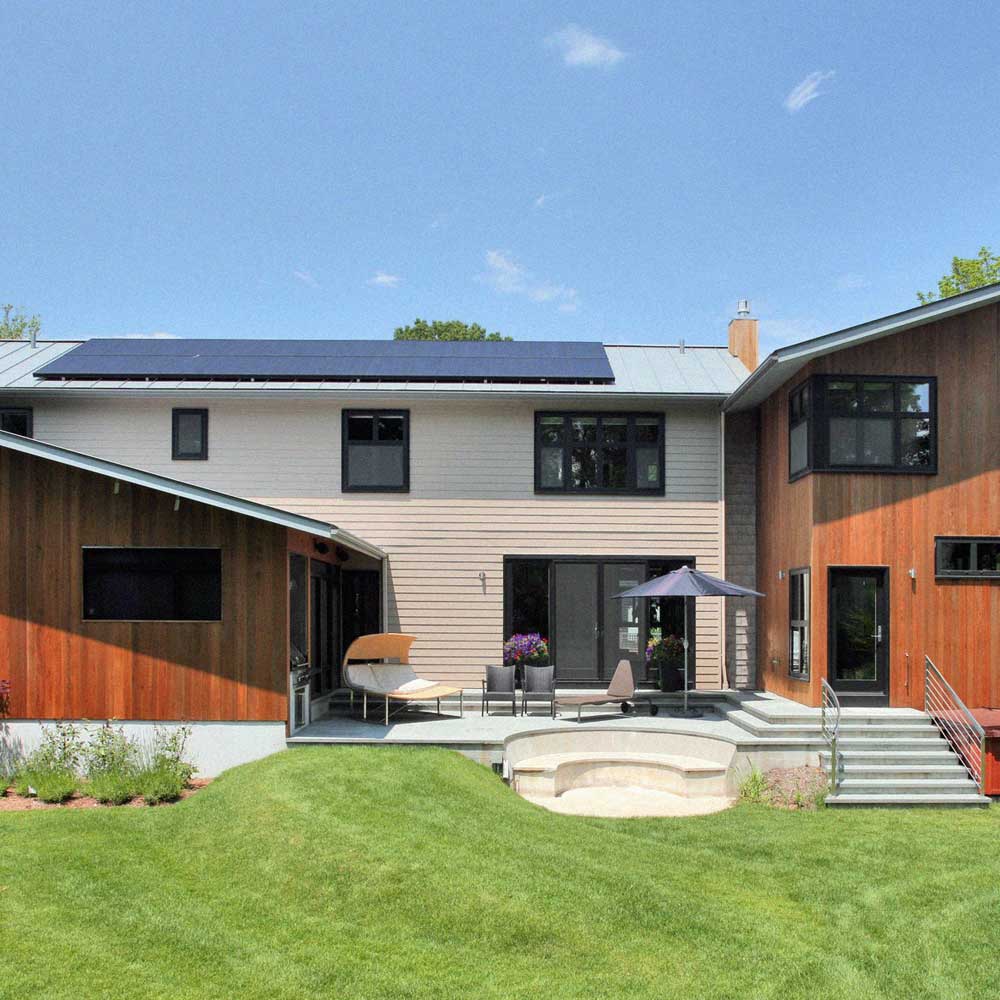
Ideally, solar panels mounted on a standard pitch roof should face south, allowing for maximum production. If your panels face southeast or southwest, you can expect them to generate roughly 10% less power. Nonetheless, that still may be enough to power your home.
If you can’t install your solar panels facing south, consider these alternatives:
Check out our easy-to-use solar potential calculator to find an estimate of your home's solar potential. An installation professional can also use technology to track how the sun hits your home. That knowledge lets them install your panels facing the right direction at the right tilt.
Going solar is a smart life decision at any time. That said, installing your solar panel system right before summer reaps you the most benefits.
You can potentially keep your home up to 5 degrees Fahrenheit cooler by shading your roof. Naturally, that's especially helpful over the warm summer months — it means a 38% reduction of your home’s annual cooling load.
Transitioning to solar power not only saves you money on your electricity bill but also can help you keep your lights on when the summer heat climbs — and outages are more likely.
Because electricity rates can be volatile over the summer, it’s smart to go solar before the hot season starts. To be clear, anytime is a good time to go solar.
We hope our beginner's guide to solar panels helps you feel more comfortable with solar power's many moving parts.
Going solar provides numerous benefits — you gain energy independence while saving money. It’s one of the wisest financial investments you can make in your life.
Don’t let anything stand between you and installing the system of your dreams. An experienced, trustworthy solar panel installer can help you harness the sun's power no matter where you live or which direction your roof faces.
As an experienced solar panel company Freedom Solar, we've been leading commercial and home solar installation, and we’d love to help you. Contact us today for a free consultation to get started.