Backup Power
Schedule a Free Consultation
If you live in Texas, you’ve seen Base Power investing heavily in advertising their low-cost home battery backup: A big battery, a small price, and a promise that you can ditch the generator. The going rate is around $695 to install and about $19 a month.
We’ll shoot straight with you: that’s a real product, from a real company, and for some households it’s a reasonable deal. We’re not here to tell you it’s a scam, because it’s not.
We’re here to explain the trade behind the price. After 19 years and 28,000+ homes and businesses across Texas, we’ve learned that the fine print matters most on day three of an outage, not day one. And lately, we’ve had to turn away homeowners who wanted to add solar and couldn’t, because of a battery agreement they signed without knowing what was in it.
So before you put any backup power system to your house, here’s what to know.
The companies offering ultra-cheap home batteries aren’t in the battery business. They’re in the grid business.
Here’s how it works. Texas has a deregulated electricity market where wholesale prices swing wildly: cheap at 3 a.m., sometimes brutally expensive on a 105° August afternoon. A company that controls thousands of home batteries can charge them when power is cheap and discharge them to the grid when prices spike. The industry calls this a virtual power plant, and honestly? It’s good for the grid. More storage on the ERCOT system helps everyone.
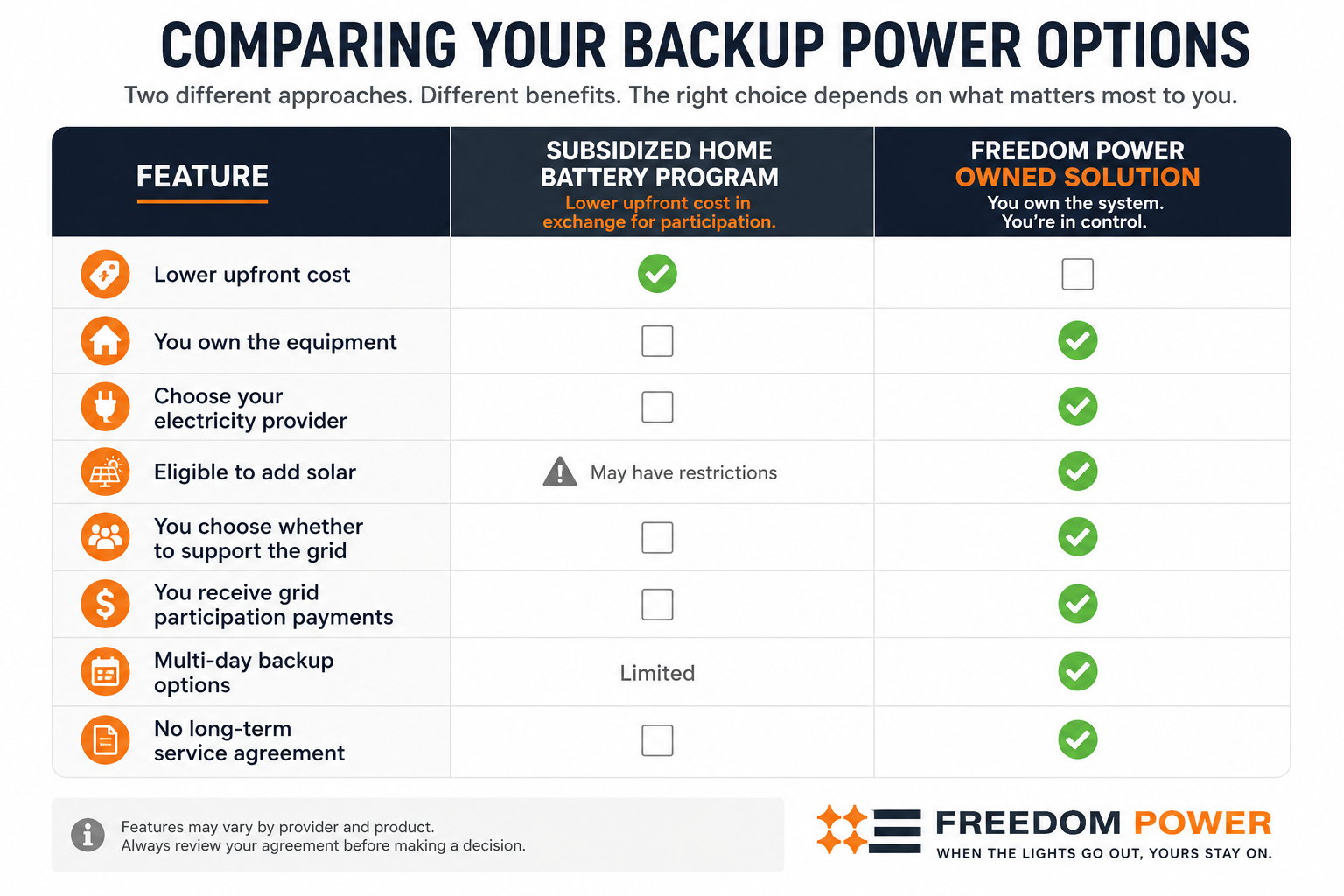
That’s why the battery is so cheap. You’re not really the customer — you’re the host site. The company subsidizes the hardware because your battery earns money for them sitting on your slab. In exchange, you get lower-cost equipment and, typically, a requirement to buy your electricity from them for as long as you keep it.
Nothing shady about that model, as long as everybody understands the deal. So let’s make sure you do.
Before we go any further, you should know that Freedom Power offers an electricity plan that can tap home batteries to support the grid. We think these programs are good for Texas, and we’re not going to pretend otherwise.
Here’s how ours works, so you can compare: you own the battery, outright. You choose whether to enroll. When your battery supports the grid, you’re the one who gets paid for it. And if you want out, you leave.
That’s the whole difference in four sentences, and it’s why we’re comfortable explaining exactly how these programs work. The question was never whether a battery should help the grid. It’s whether the person who bought the house gets a say, and a share.
1. Who owns it? With a subsidized grid battery, the company owns and controls the system, often called a virtual power plant. Keep their electricity plan, keep the battery. Want to leave for a cheaper provider? That’s a problem. Selling your house? The battery agreement comes along, and transferring it can add steps and time to your closing. A system you buy is yours the day it’s commissioned, whether that’s a Generac whole-home generator, a solar array, or a battery you own outright. It’s equipment, like your A/C. Nobody calls your air conditioner’s manufacturer for permission to sell your house.
2. Who does it work for when it matters? A grid-services battery has two jobs: earn money for the company during normal times, and back up your home during outages. The company’s own materials say they reserve a minimum backup for you, about five hours at low usage on a single battery. Five hours is plenty for the average Texas outage. But the hours when your battery is most valuable to the grid are exactly the hours before things go wrong. Prices don’t spike after a February freeze knocks out power. They spike in the tense day or two before, when the whole state is bracing. How full your battery is when your street goes dark depends on the contract, not the billboard. A Generac whole-home generator has one job and one customer. When the grid goes down, your generator doesn’t check with anyone first.
3. What refills it on day three? Any battery, no matter how big, only stores power. It can’t make any. A whole-home Generac connects to your natural gas (or propane) line and makes its own power for as long as the gas flows. Through the night, through the week if it has to. February 2021 wasn’t a two-hour event. It was four days. That’s the outage Texans actually buy backup power for. And if you want to make your own power without fuel: solar panels paired with a battery you own keep recharging every time the sun comes up, even with the grid down.
Fair is fair. A subsidized grid battery is a reasonable fit if: your outages are typically short (a few hours, a few times a year); you’re comfortable staying on the company’s electricity plan long-term; you have no plans to add solar; you aren’t planning to sell soon; and budget is the deciding factor, full stop. If that’s you, it’s a fine product. We’d rather you buy the right thing for your house than the biggest thing on our truck.
Think harder if any of these sound familiar: you bought backup power because of February 2021 (multi-day Texas power outages where storage-only systems hit their ceiling); you want solar, now or someday (we’ve had to turn away homeowners whose battery company won’t integrate); you run a big home in a Texas summer (backup that can’t carry your A/C in August, for days, isn’t whole-home backup); you might move (owned equipment adds value; a service agreement adds paperwork); or you just don’t like strings. Some people want their backup answering to them alone. We understand. It’s in our name.
Print this. Ask every company that quotes you, Freedom Power included:
A company with good answers will love these questions. A company that changes the subject just answered all five.
For a little while, yes. The problem is what "entire house" means in Texas. Central air conditioning and electric heat are the hungriest things you own (they make up about 50% of Texans’ home electricity usage), and they're exactly what you need in the outages that matter. A battery can run the essentials comfortably: fridge, lights, Wi-Fi, some outlets. Ask it to also carry your A/C in August or your heat in February and even a large battery drains fast. Whole-home power for days at a time is what standby generators are built for.
A battery stores power. A generator makes it. That one difference decides almost everything else. A battery is quiet, switches over instantly, and is limited by whatever charge it's holding when the lights go out. A whole-home generator connects to your natural gas line and produces its own power for as long as the gas flows, sized to run the entire house, air conditioning included. One more difference worth checking: you own your generator outright. Some subsidized batteries are owned and controlled by the company that installed them, which means someone else decides how the battery gets used.
It depends entirely on what you're running. Advertised backup times of 36 to 72 hours assume very light loads: a refrigerator, a freezer, some lights, a fan, Wi-Fi, and a laptop, with no heating or cooling at all. Run the house more normally, with heating or cooling on, and one provider's own calculator puts backup at roughly 3.8 hours. That gap is the whole story. A February freeze is precisely when you can't turn the heat off, and it's also when a multi-day outage is most likely. Before you buy any battery, ask for the runtime estimate with your A/C or heat included, in writing.
If you own the battery, usually yes. If a company owns or controls the battery, possibly not. Some battery providers require their own equipment and software to run the system, which blocks integration with solar installed by anyone else. We hear this one firsthand: homeowners come to us wanting panels and we have to turn them away because their battery agreement won't allow it. If solar is anywhere in your future, even years out, ask the battery company one question before signing: "Can I add solar from any installer later?" Get the answer in writing.
If you bought the battery, nothing happens. It's part of the house, like your A/C, and owned equipment generally adds value to the sale. If the battery belongs to a company and sits on your slab under a service agreement, that agreement has to transfer to the buyer, which can add steps and time to your closing. It's worth asking about before you sign, not the week you list the house.
It depends on the outage you're preparing for. For short, occasional outages of a few hours, a battery handles it quietly and automatically, and a battery you own is a great piece of equipment. For the multi-day events Texas actually plans around, a whole-home generator on natural gas keeps making power long after any battery is spent. Solar panels paired with a battery you own sit in between: they recharge every time the sun comes up, even with the grid down. We install all three, so we don't have a horse in this race beyond getting it right for your house. Answer three questions honestly: Who owns the equipment? Who controls it when the grid is strained? And what will still be making power on day three?
Freedom Power provides backup power systems including solar, batteries, and Generac whole-home generators under one roof. We’re a Generac platinum-level certified dealer and installer and a Tesla Powerwall Certified Premium Installer, which means we don’t need to steer you toward one predetermined product. We handle everything from permits and gas lines to wiring and commissioning, and we’re still here after the install. Not our first rodeo.
WHEN THE LIGHTS GO OUT, YOURS STAY ON. SCHEDULE A CONSULTATION WITH OUR TEAM.